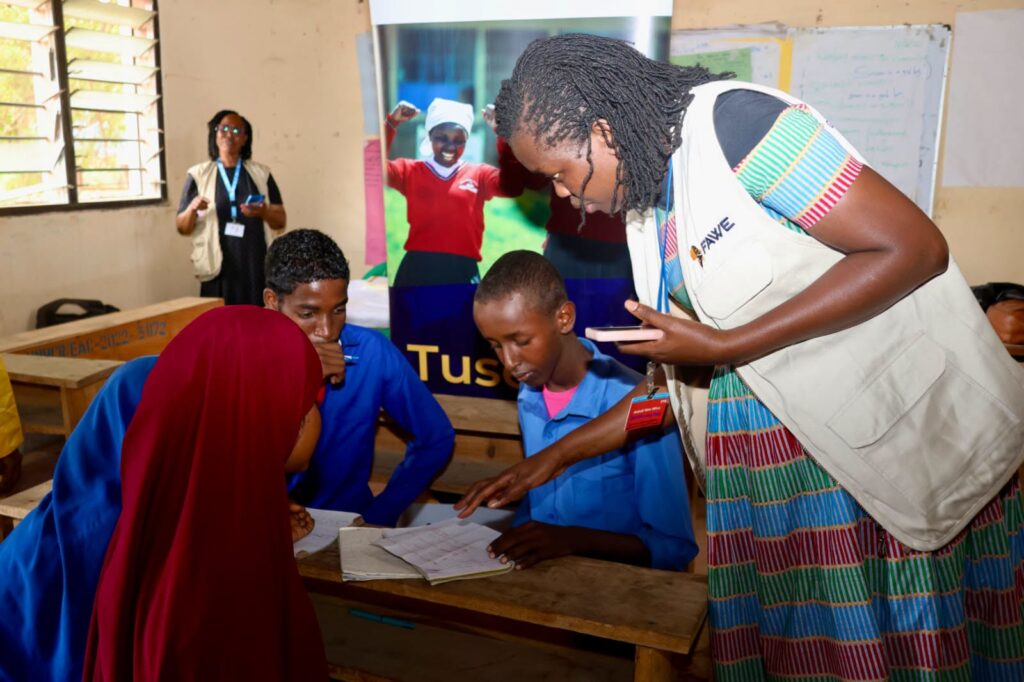
On 19 June, the GPE KIX Tuseme Project convened an exchange and learning session at Central Hagadera Comprehensive School in the Dadaab Refugee Camp, part of the Dadaab Refugee Complex in Garissa County, northeastern Kenya. The event brought together education stakeholders to reflect on the realities facing refugee learners and to identify practical, community-led solutions that promote equitable, inclusive, and gender-responsive education. The initiative reaffirmed FAWE’s commitment to ensuring that even the most marginalized children and young people have access to safe, quality learning opportunities.
The facilitation team comprised Rose Atieno, Programme Officer at FAWE Regional Secretariat (FAWERS); Lawrence Amwayi, Finance Assistant at FAWE Regional Secretariat; colleagues from FAWE Kenya; and HERS-EA. Together, they guided interactive discussions that encouraged collaboration among representatives from the Ministry of Education, teachers, school leaders, community members, civil society organizations, and development partners, including the Lutheran World Federation (Kenya/Somalia Office). The diverse participation created a valuable platform for sharing experiences and strengthening partnerships to improve education outcomes for refugee communities.
Participants openly discussed some of the most pressing barriers affecting refugee learners, including language challenges resulting from the shortage of government-recruited teachers and the persistent issue of teenage pregnancy. Through the Tuseme Clubs approach, stakeholders explored locally driven solutions that empower learners to identify challenges, express their concerns confidently, and become active contributors to positive change within their schools and communities. The discussions demonstrated how the Tuseme methodology continues to provide a powerful platform for promoting student voice, leadership, and resilience.
The engagement also reinforced the importance of collaborative action in addressing complex educational challenges in humanitarian settings. By bringing together government institutions, development partners, educators, and communities, the session strengthened collective ownership of interventions that support girls’ education, gender equality, and social inclusion. Participants reaffirmed their commitment to creating learning environments where every child—regardless of circumstance—could participate, succeed, and realize their full potential.
The learning session formed part of a broader programme of activities that culminated in participation in the World Refugee Day commemorations on 20 June, which enhanced the visibility of the GPE KIX Tuseme Project and its contribution to refugee education. This was followed by a leadership training on 21 June that strengthened the capacity of key stakeholders to sustain and scale the Tuseme intervention. Together, these engagements demonstrated the transformative power of partnership, local leadership, and evidence-based approaches in advancing inclusive education for refugee girls and boys across the region.