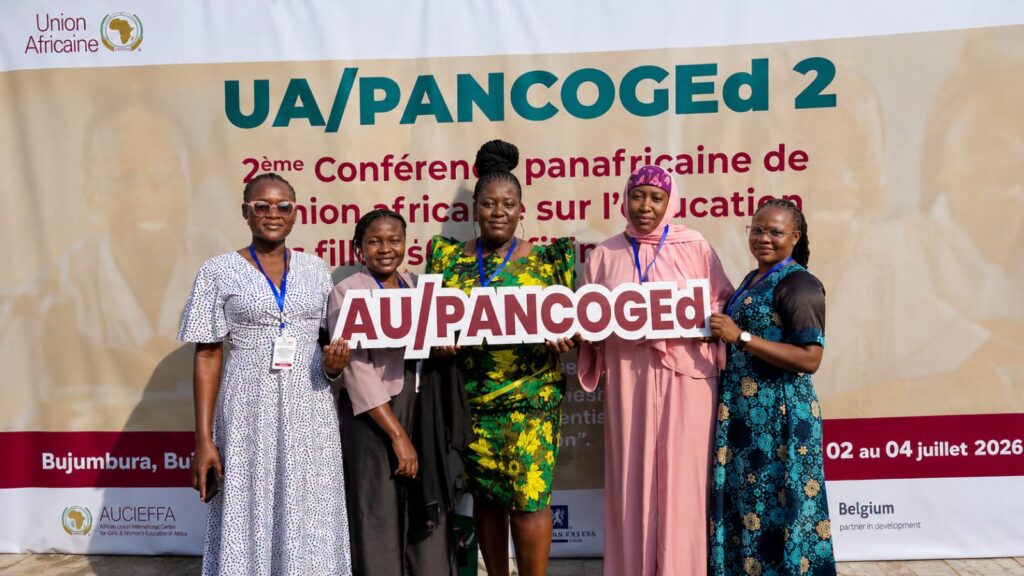
FAWE Africa emerged as a powerful voice at the Second AU Pan-African Conference on Girls’ and Women’s Education (PANCOGED II), held from July 2-3, 2026, in Bujumbura, Burundi. Convened by the African Union International Centre for the Education of Girls and Women in Africa (AU/CIEFFA) under the theme “Prioritising Girls’ and Women’s Education: Develop Their Skills and Accelerate Learning and Training Opportunities,” the conference brought together over 400 participants from across the continent, including ministers, policymakers, education experts, youth representatives, and development partners. The conference, officially opened by H.E. Prosper Bazombanza, Vice President of the Republic of Burundi, represented a landmark moment in the continental commitment to advancing girls’ and women’s education.
FAWE’s delegation, led by Executive Director Dr. Martha Muhwezi, co-hosted a pivotal side event alongside World Vision Burundi, ACERWC, Jesuit Refugee Service, Bibliothèques Sans Frontières, OAFLAD/OPDAD, and OAFLAD on “Gender-Responsive, Climate-Resilient Education in Emergencies: Reintegration, Safe Learning Spaces and Digital Access for Displaced Girls and Young Women.” Moderated by FAWE Africa’s Senior Advocacy and Partnerships Officer Catherine Asego, the session highlighted practical solutions for ensuring girls continue learning in crisis contexts. FAWE Africa’s Senior Knowledge Management Officer Gordon Aomo shared compelling evidence from the GPE KIX Tuseme Project, demonstrating how the model strengthens girls’ voice, leadership, agency, and participation in refugee and internally displaced communities.
A highlight of the conference was the powerful testimony of Hellen Mwandila, a participant in the FAWE/Mastercard Foundation Second Chance Pathways Programme from Zambia. Currently pursuing a Certificate in General Agriculture, Hellen shared her inspiring journey of resilience and determination to become an agriculture specialist. “I stand here today because someone believed that my circumstances should never define my future. Every girl, no matter where she comes from, deserves that same opportunity,” she declared, moving the audience with her conviction. Her presence at the conference underscored the transformative power of education and the importance of creating pathways for marginalised young women to access tertiary education and meaningful careers.
Dr. Martha Muhwezi also participated in a high-level roundtable discussion on 21st Century Skills Development for TVET and STEAM for Girls and Women in Africa, bringing together education leaders and experts from across the continent. During the dialogue, Dr. Muhwezi emphasised that investing in girls’ education is not only a matter of equity but a strategic investment in Africa’s human capital. She highlighted the importance of gender-responsive education systems, stronger STEM and TVET pathways, teacher capacity development, and partnerships that enable girls to transition successfully into higher education, employment, and entrepreneurship. “Africa cannot achieve its development aspirations if half of its talent is left behind,” she asserted, calling for renewed commitment to inclusive educational systems.
The conference concluded with the adoption of the Bujumbura Declaration and Call to Action, committing member states to comprehensive approaches that integrate nutrition, water, sanitation, and hygiene as pillars of school retention, alongside revitalised technical and vocational education and STEM pathways. FAWE’s active participation in the conference reinforced its position as a key continental actor in advancing girls’ education and women’s leadership. As the organisation continues to implement programs that empower girls and young women across Africa, its involvement in PANCOGED II has strengthened partnerships and amplified the imperative of leaving no girl behind. “When girls are equipped with the right skills, opportunities, and support, they become innovators, leaders, and drivers of sustainable development,” Dr. Muhwezi concluded, capturing the spirit of the conference and the promise of Africa’s future.