At the 3rd Africa Skills Week 2026 in Harare, Zimbabwe, one young woman found something she had been searching for her whole life: proof that she belongs.
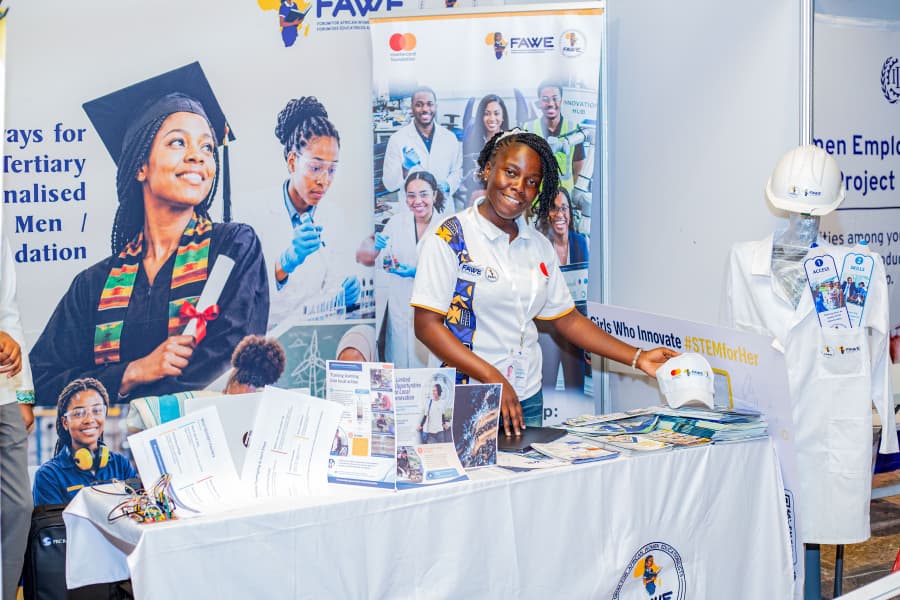
Some women wait for a seat at the table.
Tatenda Fungai Mudengu is building her own table — from concrete, steel, and unshakeable determination.
A civil engineering student at Harare Polytechnic and a participant in the FAWE/Mastercard Foundation Second Chance Pathways for Increased Access to Tertiary Education for Marginalized Young Women and Men Program, Tatenda is not just studying to become an engineer. She is studying to become proof — proof that young women from marginalized backgrounds can rise, lead, and build the Africa we all deserve.
And at the 3rd Africa Skills Week 2026 in Harare, Zimbabwe, she found a room full of people who believed in that same vision.
The 3rd Africa Skills Week is more than a conference. It is a continental gathering of dreamers, builders, innovators, and change-makers — all united by a shared belief that Africa’s future will be shaped by its skills.
For Tatenda, the experience was nothing short of transformational.
“My experience at the 3rd Africa Skills Week 2026 was amazing,” she says. “I felt what it feels like to be part of an African team pursuing skills that will put Africa on the map.”
That sense of belonging — of being part of something bigger than herself — is something Tatenda had not always felt. As a young woman entering a male-dominated field, she had grown accustomed to being outnumbered. To being underestimated. To being the only woman in the room.
But Africa Skills Week 2026 changed that.
One of the most powerful moments of Tatenda’s journey came when she encountered something she had rarely seen: successful female engineers.
“I got an opportunity to hear and socialize with many female engineers who succeeded,” she recalls. “This encouraged me to do all things related to me gaining skills that will someday help me uplift and give back to the community I came from.”
There is a quiet magic in seeing someone who looks like you, who has walked the road you are walking, and who has arrived. For young women in STEM — especially in fields like civil engineering, where women remain significantly underrepresented — that magic can be the difference between giving up and pressing forward.
For Tatenda, it was fuel.
“My confidence improved as a female entering the male-dominated industry,” she says. Those words carry the weight of a thousand small battles — the moments of doubt, the whispers of “you don’t belong here,” the silent pressure to be twice as good to be seen as half as capable.
At Africa Skills Week 2026, those whispers were silenced.
Tatenda’s experience was not limited to Zimbabwe. She met people from across Africa and beyond — engineers, innovators, entrepreneurs, and students — each carrying their own skills, their own stories, their own dreams.
“I have had the opportunity to meet various people from different African countries as well as international countries with different types of skills,” she says. “Some of the skills are also related to the program I am pursuing.”
That exposure did more than expand her network. It expanded her sense of what is possible.
“As I met these people, I felt encouraged to continue excelling in what I am currently doing,” she says.
For a young woman who has already defied the odds to pursue her dreams, that encouragement is everything. It is the wind beneath wings that were always meant to fly.
The Second Chance That Changed Everything
Tatenda’s journey is a testament to the power of second chances.
The FAWE/Mastercard Foundation Second Chance Pathways Program exists for young people like Tatenda — those who, for reasons beyond their control, were marginalized, overlooked, or denied access to tertiary education. The program does not just open doors. It builds bridges. It says to young women and men who have been left behind: Your future is not over. It is just beginning.
Tatenda is living proof.
Through the program, she has gained access to an education that will allow her to enter a field where she can build infrastructure, solve problems, and contribute to Africa’s development. And she is not taking that opportunity lightly.
“I felt encouraged to continue excelling in what I am currently doing,” she says. “To gain skills that will someday help me uplift and give back to the community I came from.”
Giving Back: The Heart of Her Mission
For Tatenda, success is not measured by personal achievement alone. It is measured by impact. By service. By how many people she can lift as she climbs.
“I want to use my skills to uplift and give back to the community I came from,” she says. Those words reveal a maturity beyond her years — a recognition that her journey is not just about her. It is about every young girl who will come after her. Every family that will benefit from her success. Every community that will be transformed because one young woman refused to give up.
In a continent where young women still face significant barriers to education and employment, Tatenda’s determination to give back is not just inspiring. It is essential.
As Africa invests in infrastructure — roads, bridges, water systems, buildings — the need for skilled civil engineers has never been greater. And as the continent works to close gender gaps in STEM, the need for women like Tatenda has never been more urgent.
Tatenda is not just entering the field of civil engineering. She is helping to redefine it. She is showing other young women that they, too, can wear hard hats. They, too, can design structures. They, too, can build the future.
“I felt what it feels like to be part of an African team pursuing skills that will put Africa on the map,” she says.
That team is stronger because she is on it.
The Takeaway: Belonging, Building, Becoming
Tatenda Fungai Mudengu’s story is a reminder that talent is everywhere, but opportunity is not. It is a reminder that second chances can change lives. And it is a reminder that when young women are given the tools, the mentorship, and the belief they need, they don’t just succeed.
They soar.
As she continues her studies at Harare Polytechnic, Tatenda carries with her the lessons of Africa Skills Week 2026: that she belongs, that her skills matter, and that her future is bright.
She came to Harare as a student. She left as a force.
And the infrastructure of tomorrow — the bridges, the buildings, the systems that will connect and sustain Africa — will be stronger because Tatenda Fungai Mudengu helped build them.
Tatenda Fungai Mudengu is a civil engineering student at Harare Polytechnic and a participant in the FAWE/Mastercard Foundation Second Chance Pathways for Increased Access to Tertiary Education for Marginalized Young Women and Men Program, from FAWE Zimbabwe Chapter . She is passionate about engineering, community development, and empowering young women in STEM.
This article is part of our series spotlighting young African changemakers participating in the 3rd Africa Skills Week 2026. Follow us for more stories of skills, innovation, and transformation across the continent.