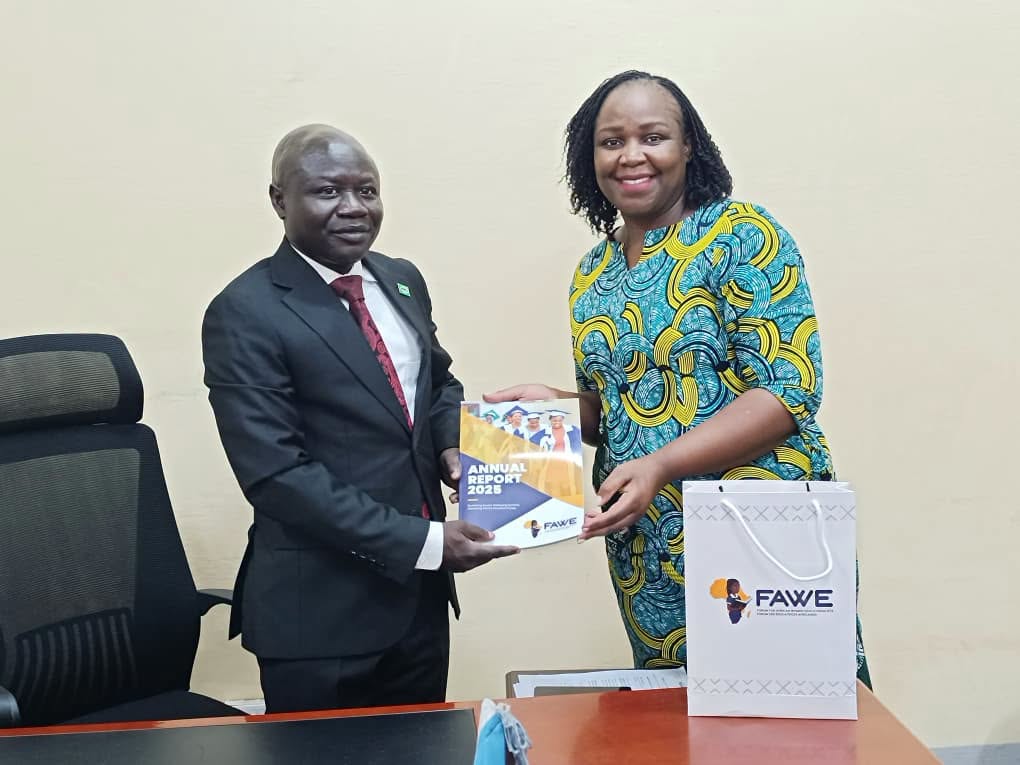
JUBA, South Sudan – On 15 July, a delegation from FAWE Africa, led by Teresa Omondi-Adeitan, Deputy Executive Director and Head of Programmes, paid a courtesy visit to Hon. Lupai Satimon Andrew, State Minister of General Education and Instruction. The meeting marked a pivotal moment in the ongoing partnership between FAWE and the Government of South Sudan, reaffirming their shared commitment to advancing girls’ education through evidence-based and gender-responsive interventions .
Hon. Lupai Satimon Andrew acknowledged the persistent gender disparities within the education system, noting that recent examination results show girls consistently underperforming compared to boys. He highlighted the urgent need for targeted interventions and emphasized the critical shortage of teachers—particularly female teachers—as a significant barrier to progress. The Minister welcomed FAWE’s planned Gender-Responsive Pedagogy training as a timely investment in improving teaching and learning outcomes, stating: “Sustainable change happens when development partners work alongside government—not around it. We welcome FAWE’s partnership because it strengthens national priorities while building the capacity of our own education system to deliver lasting results for every child” .
Teresa Omondi-Adeitan reaffirmed FAWE’s commitment to working hand in hand with the Ministry to ensure that every intervention is nationally owned and contributes to long-term systems strengthening. “FAWE’s role is to work alongside the Ministry, strengthening national priorities through evidence-based programmes that improve girls’ enrolment, retention, learning outcomes, and transition to brighter futures,” she stated. The meeting reinforced the shared commitment to strengthening South Sudan’s education system through partnership, national ownership, and coordinated action .
The following day, on 16 July, FAWE convened government representatives, civil society organizations, development partners, educators, and community stakeholders in Juba to disseminate findings from a baseline study on teenage pregnancy, the implementation of the Maputo Protocol, and the Safe Schools Declaration. The workshop, held under the ECHIDNA III Programme, provided a platform for stakeholders to examine the evidence, identify priority actions, and strengthen collective efforts to ensure that every girl can learn in a safe, inclusive, and supportive environment. Teresa Omondi-Adeitan emphasized that sustainable solutions must come from those closest to the challenges: “The solutions to the issues we are discussing today already exist within this room” .
The baseline study revealed that teenage pregnancy is not an isolated challenge but is closely linked to school-related gender-based violence, child marriage, harmful social norms, poverty, inadequate sexual and reproductive health services, long distances to school, insecurity, and limited opportunities for girls. Addressing these interconnected barriers requires coordinated action across communities, schools, and government institutions. Through the ECHIDNA III Programme, FAWE remains committed to working alongside the Government of South Sudan and its partners to strengthen policies, promote safe learning environments, and ensure that more girls are able to enrol, stay in school, and succeed.
On 17 July, FAWE South Sudan successfully concluded its General Assembly in Juba, marking a significant milestone in strengthening the Chapter’s governance and positioning it to deepen its contribution to education transformation in the country. The General Assembly brought together members, government representatives, and partners to reflect on the Chapter’s progress and elect a new Board that will provide strategic leadership and oversight .
The newly elected Board comprises Dr. Kushaba Annet Marko Okello as Chairperson, Ms. Kiden Civilian as Deputy Chairperson, Ms. Night Agnes Wani as Board Secretary, Ms. Achol Aguek as Board Treasurer, and Ms. Sylvia Michael, Ms. Medakpwe Irene, and Ms. Jemima Michael as Board Members. Dr. Marko Okello pledged to build a strong, accountable, and impactful Chapter, stating: “We are honoured by the trust placed in us and fully committed to working collaboratively with government, partners, and communities to advance FAWE’s mission and expand its impact across South Sudan” .