As 2030 approaches, It is important to recall Africa’s access to education story, one of both remarkable progress and unfinished business. Over the past 25 years, millions more boys and girls have entered classrooms, stayed in school longer and completed their education. Yet behind averages, deep inequalities remain, particularly for girls living in rural areas, in poor households and in areas affected by conflict.
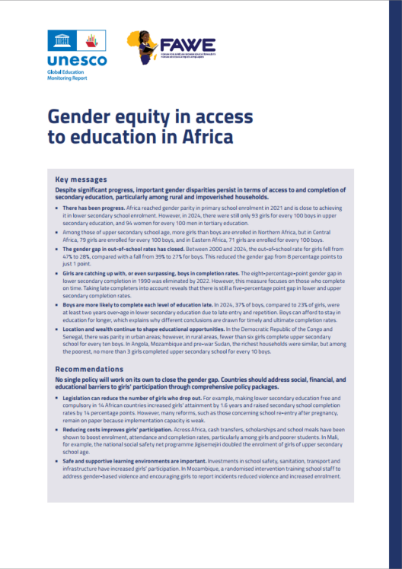
A partnership between the Global Education Monitoring Report and the Forum of African Women Educationalists (FAWE) has led to the release of new evidence in a report on gender equity in access to education in Africa. It shows that the challenge facing governments now is not only to reach girls still excluded into school, but to ensure they have equal opportunities to continue and complete secondary school and university. It repeats a general message from the 2026 GEM Report on access and equity: that there is no one policy solution that ‘works’. A mix of policies is needed to address the different barriers preventing full gender equity in education.
A generation of progress in primary and lower secondary education
In a context of much global negative news about trends in education, the scale of progress in gender equitable access should not be underestimated.
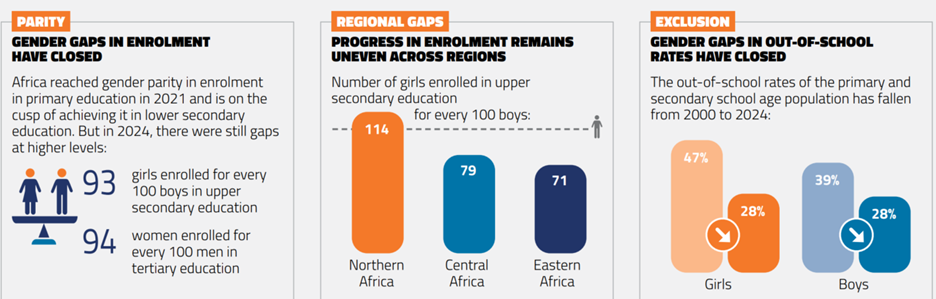
In primary education, Africa has travelled a long way from the severe gender disparities of previous decades. In 1970, only 69 girls were enrolled in primary education for every 100 boys. By 2000, that figure had risen to 86. Gender parity was finally achieved in 2021. Progress has also been strong in lower secondary education, where in 2024 there were just fewer than 97 girls enrolled for every 100 boys, and parity is now within reach.
The gains are equally evident in school participation. Between 2000 and 2024, the out-of-school rate among girls of primary and secondary school age fell from 47% to 28%. Among boys, it declined from 39% to 27%. The gender gap in school exclusion has almost disappeared.
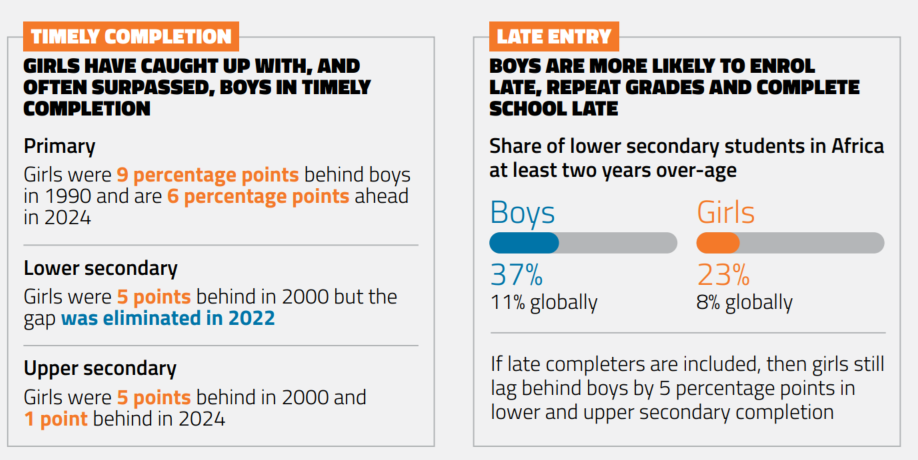
Completion rates tell a similarly transformative story. The nine percentage point gender gap in primary completion in favour of boys in 1990, has reversed and girls are more likely than boys to complete primary school on time. In lower secondary education, the five percentage point gender gap that existed in 1990 was closed in 2022.
Upper secondary and tertiary education continue to pose challenges
In 2022, the GEM Report’s annual gender publication and campaign called to ‘Deepen the debate’ on discussions about gender equity and equality in education. The closer one looks into the data, the more nuances reveal themselves.
While parity has been achieved in primary and lower secondary education, there were still only 93 girls enrolled in upper secondary education for every 100 boys across Africa in 2024. At the tertiary level, there were 94 young women enrolled for every 100 young men.
Regional differences are striking, showing that there is no single African story. Northern Africa now enrols more girls than boys in upper secondary education, while Southern and Western Africa are approaching parity. But in Central Africa there are only 79 girls enrolled for every 100 boys, and in Eastern Africa just 71 girls for every 100 boys.
The hidden story behind completion rates
As we lean into the need to deepen the debate, one of the most interesting findings in the policy paper concerns how completion is measured.
The official SDG indicator assesses whether young people complete school within a reasonable period of three to five years after reaching graduation age (timely completion). Using this measure, girls appear to have caught up with boys and, in some cases, overtaken them, as shown above.
But when those who complete education even later than that (what might be called ultimate completion), a different picture emerges. Boys are far more likely to enter school late, repeat grades and eventually complete their education at older ages. When these late completers are counted, the gender gap grows from one to five percentage points. In other words, girls may be just as likely as boys to complete upper secondary school on time, but boys are more likely to remain in school long enough to finish eventually.
This finding reflects the pressures many girls face as they grow older, notably early marriage and early pregnancy that make it harder to continue their education.
Poverty and geography matter as much as gender
The paper includes an analysis of data from the Worldwide Inequality Database on Education (WIDE) showing that where a girl lives and how wealthy their household is can have a sizeable influence on educational opportunities.
In countries such as the Democratic Republic of the Congo and Senegal, gender parity has effectively been achieved in urban areas. Yet in rural areas, fewer than 6 girls complete upper secondary school for every 10 boys.
The disparities become even more severe when wealth is considered. In Angola, Mozambique and pre-war Sudan, among the poorest households, at most 3 girls complete upper secondary school for every 10 boys. Yet among the richest households in some of these same countries, boys and girls complete upper secondary education at almost equal rates.
These findings underline the need to look beyond averages as we deepen the debate. A country may appear close to achieving gender parity overall while still leaving poor rural girls with little chance of completing school.
Taking a longer term approach to finding solutions
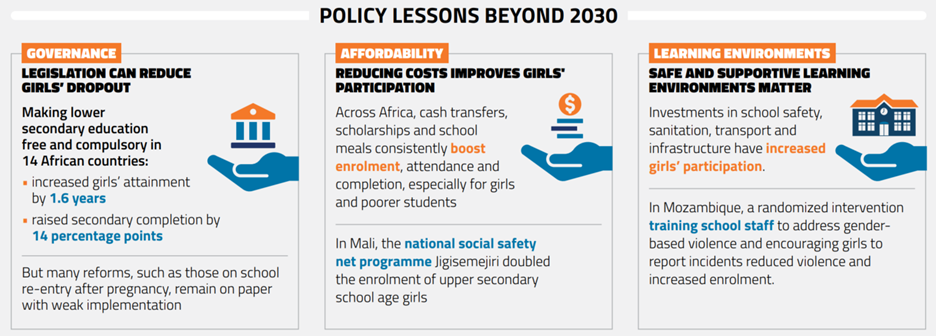
The evidence reviewed in the report points to several interventions that have successfully improved girls’ participation and completion.
- Legislation matters. Making lower secondary education free and compulsory in 14 African countries increased girls’ educational attainment by 1.6 years and raised secondary completion rates by 14 percentage points.
- Reducing financial barriers also works. Cash transfers, scholarships and school meal programmes have consistently improved enrolment, attendance and completion, especially for girls and disadvantaged learners. In Mali, the national social safety net programme Jigisemejiri doubled enrolment among girls of upper secondary school age. Safe and supportive schools are equally important.
- Investments in sanitation, transport, school infrastructure and protection from gender-based violence have all been shown to increase girls’ participation. In Mozambique, training school staff to address gender-based violence and encouraging girls to report incidents reduced violence and increased enrolment.
But the wider lesson from the 2026 GEM Report which rings true in today’s paper is that no single intervention is enough. Countries that have made the fastest and most equitable progress have not relied on a single reform or imported a policy from elsewhere. Instead, they have made policy choices that respond to their own contexts, adapting ideas to local realities, reflecting each country’s unique combination of opportunities, constraints and institutional capacity.