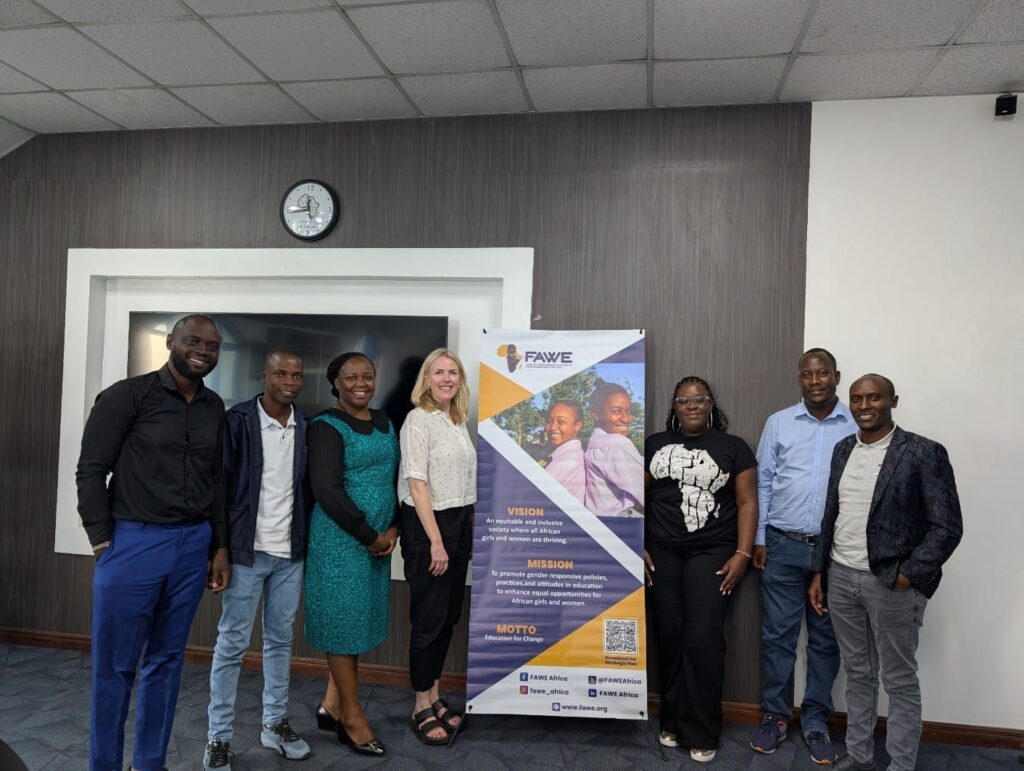
In a powerful demonstration of how education and environmental sustainability can reinforce one another, the FAWE Regional Secretariat recently welcomed Ms. Gudny Nielsen, Founder of Katla Carbon, from Iceland for strategic discussions on climate action and girls’ education.
The engagement highlighted a growing global recognition: investing in girls’ education is not only a matter of equity and human rights—it is also a climate solution.
At the heart of the discussions was an innovative collaboration underway in Zambia, where FAWE and Katla Carbon are piloting a groundbreaking model that channels climate financing directly into girls’ education initiatives. This partnership represents one of the first efforts to intentionally connect climate finance mechanisms with expanding educational opportunities for girls, demonstrating how environmental and social impact can be mutually reinforcing.
Linking Climate Finance and Educational Opportunity
Across Africa, climate change disproportionately affects vulnerable communities, disrupting livelihoods, education systems, and household stability. Girls are often among the most affected—facing increased risks of school dropout, early marriage, and reduced economic opportunities in the wake of climate-related shocks.
By exploring ways to align climate financing with investments in education, FAWE and Katla Carbon are working to build a model that strengthens community resilience while expanding access to quality learning opportunities.
The Zambia initiative seeks to demonstrate that climate mitigation and adaptation investments can generate social returns when they are designed with education and gender equity at their core. By channeling resources into scholarships, school support systems, and empowerment programmes, climate finance can help safeguard girls’ education even in environmentally vulnerable contexts.
Education as a Climate Resilience Strategy
The meeting underscored a powerful truth: educating girls strengthens climate resilience at multiple levels.
Educated girls are more likely to participate in community leadership, adopt sustainable practices, and contribute to informed decision-making within households and communities. Over time, increased access to education contributes to healthier families, improved economic opportunities, and stronger local capacity to adapt to climate change.
By positioning girls’ education as an integral component of climate action, FAWE is advancing a forward-looking vision of development—one that recognises that environmental sustainability and social justice are deeply interconnected.
Pioneering a New Model for Impact
The collaboration between FAWE and Katla Carbon signals a new frontier in development partnerships. It challenges traditional silos between environmental and education sectors and offers a replicable model for aligning climate investment with gender-responsive education strategies.
As the pilot initiative in Zambia progresses, it will generate valuable lessons on how innovative financing mechanisms can support inclusive education while contributing to global climate goals.
This engagement reaffirms FAWE’s commitment to exploring bold partnerships that expand opportunities for girls and strengthen communities. It also reinforces a simple but transformative principle: when we invest in girls, we invest in sustainable development, stronger societies, and climate-resilient futures.
Through partnerships that bridge sectors and geographies, FAWE continues to champion solutions that empower girls not only to learn—but to lead in shaping a more equitable and sustainable world.